


A deep dive into 415,000+ marketing infractions, growing public backlash, and why the real battle for Ontario’s online gaming market is happening outside regulated iGaming activity.
State of play in Ontario
On the surface, Ontario’s move into regulated iGaming 4 years ago has been a relative success. Launched on April 4, 2022, the province's regulatory body, the Alcohol and Gaming Commission of Ontario (AGCO), has vetted and approved 50 active operators managing over 70 iGaming platforms.
Research from May 2026 revealed that 91.1% of Ontario bettors chose regulated, legal sites, up from 83.7% in 2025. During the 2025 calendar year, Ontario’s legal iGaming sector hit a landmark benchmark, generating C$4 billion in total gross gaming revenue, up 34% on the previous year.
These figures would please any regulatory authority, but for Ontario they mask the growing public discontent with online gambling advertising, which has exploded in the last 4 years, reaching a point of saturation.
There are also signs that problem gambling has increased, raising public concern and leading to calls for politicians to intervene.
Beneath the Surface: The Marketing Compliance Explosion
A study of data from Rightlander covering four consecutive six-month periods from July 2024 through June 2026, compliance infractions have not decreased as the market matured - they have actually increased.
A total of 415,590 compliance infractions were detected across four major areas: unlicensed operator marketing, bonus promotional violations, 19+ age messaging omissions, and responsible gambling disclosures.
Download: Ontario Compliance Infractions Study (July 2024 - June 2026)
The Two-Year Spike in Infractions
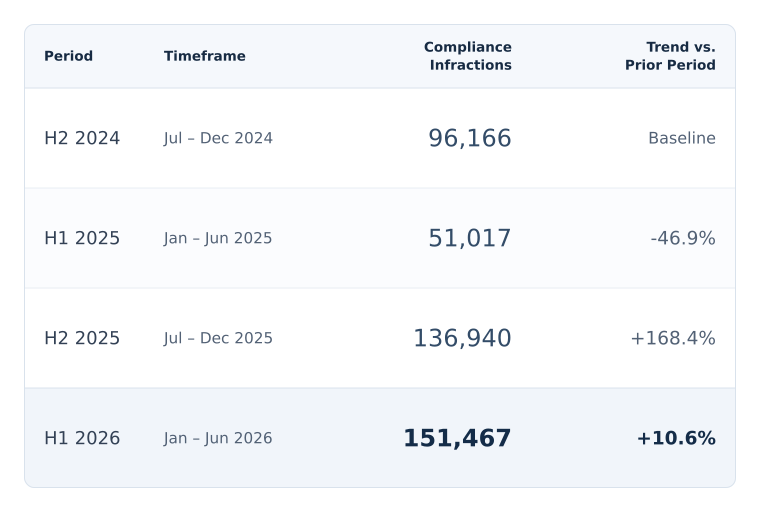
While compliance infractions briefly dropped in early 2025, they exploded in the second half of the study. In the first half of 2026 alone, Rightlander recorded 151,467 infractions, with a 10.6% increase over the second half of 2025 and a massive 65.7% rise compared to late 2024.
Compliance infractions detected between July 2024 - June 2026
Black Market Temptations and Bonus Violations
Where are these infractions coming from if 91% of players use regulated iGaming sites? The breakdown reveals two dominant areas:
1. Unlicensed Operator Promotions
The biggest driver of non-compliance is the persistent promotion of unregulated, black-market operators to Ontario residents, which make up 57% of recent infractions. Detections jumped from 51,995 in late 2024 to a peak of 85,755 in the first part of 2026 (a 65% increase).
Even though only 8.9% of players exclusively use black-market operators, unlicensed sites are appearing more frequently across affiliate content, social channels, and third-party media. The AGCO has actively pursued offenders by issuing C$40,000 in penalties to game suppliers in May 2026 for unapproved web distribution, but the volume of external promotion remains high.
2. Bonus Inducements
Bonus-related infractions are the second-largest category, climbing to 58,087 in early 2026, a 158% increase on the first half of 2025. Together with unlicensed operator promotions, bonus violations accounted for 95% of all detected infractions in the first half of 2026.
Under AGCO regulatory guidelines, directly promoting bonuses as a player-acquisition inducement on third-party affiliate channels is prohibited. While an operator's own site might be 100% compliant, third-party marketing partners have been presenting unauthorised bonus offers.
Public Backlash and the Push for a Complete Ad Ban
This sheer volume of iGaming advertising in Ontario since regulation was introduced has triggered public backlash. Ontarians have grown weary of the omnipresent betting commercials during sports broadcasts and heavy social media promotion.
Concerns over gambling harm are backed by data from ConnexOntario, the province's mental health helpline. They have reported a 144% increase in inquiries following iGaming regulation in 2022, with 76% of gambling calls linked specifically to online products.
In response to public pressure, political moves are gaining momentum. In April 2026, Liberal MPP Lee Fairclough introduced a private member's bill proposing a total ban on iGaming advertising across TV, radio, social media, and sports sponsorships.
To ensure compliance, the bill proposes punitive fines of up to C$1,000,000 per violation and potential license suspensions.

Conclusion: A path forward for Ontario
Four years into Ontario’s transition to regulated iGaming, many figures point to a strong, healthy market. Yet the Canadian province, the first to take on regulation, faces strong headwinds in the months and years ahead.
If public discontent continues, then politicians will be forced to act, introducing punitive advertising rules that come with severe penalties for non-compliance. This is not in the interest of the 50 or so companies that are already operating in Ontario. However, change is needed, as the numbers suggest that problems are creeping up, creating greater challenges for all invested parties.
The two areas identified above concerning black-market operators and bonus inducements should be a focus of attention. These will be areas of the iGaming industry that are causing problems and potential harm, so reducing them will likely be beneficial.